How I Used AI to Research and Brainstorm the FI Beacon App Idea
When people hear that I built FI Beacon with AI, they might imagine I had some brilliant master plan from day one.
I did not.
What I actually had was a server, some free time, curiosity about AI, and a vague feeling that I should probably build something before AI became even smarter and started judging my unfinished side projects.
At that time, AI tools were getting better and better. AI agents were everywhere. People were building apps, websites, tools, products… sometimes faster than I could finish my coffee. I was curious, but also skeptical. Not the dramatic kind of skeptical. More the developer kind.
The kind that says: “Yes, yes, very impressive… now please do something useful without breaking production.”
I wanted to learn how far AI could actually help with software development, but I had one big problem:
I had no idea what to build.
That turned out to be the perfect starting point.
A quick note before we continue: this post was created with the help of AI.
I use AI as a thinking partner to help me structure messy thoughts, explore ideas faster, improve flow, and sometimes save me from staring at a blank page like it personally offended me.That said, the opinions, experiences, and final judgment are still mine. AI helps me write clearer and faster, but it does not get to sneak in and become the author of my personality.
So yes, AI helped shape this post — but the relaxed coder behind it is still very much human.
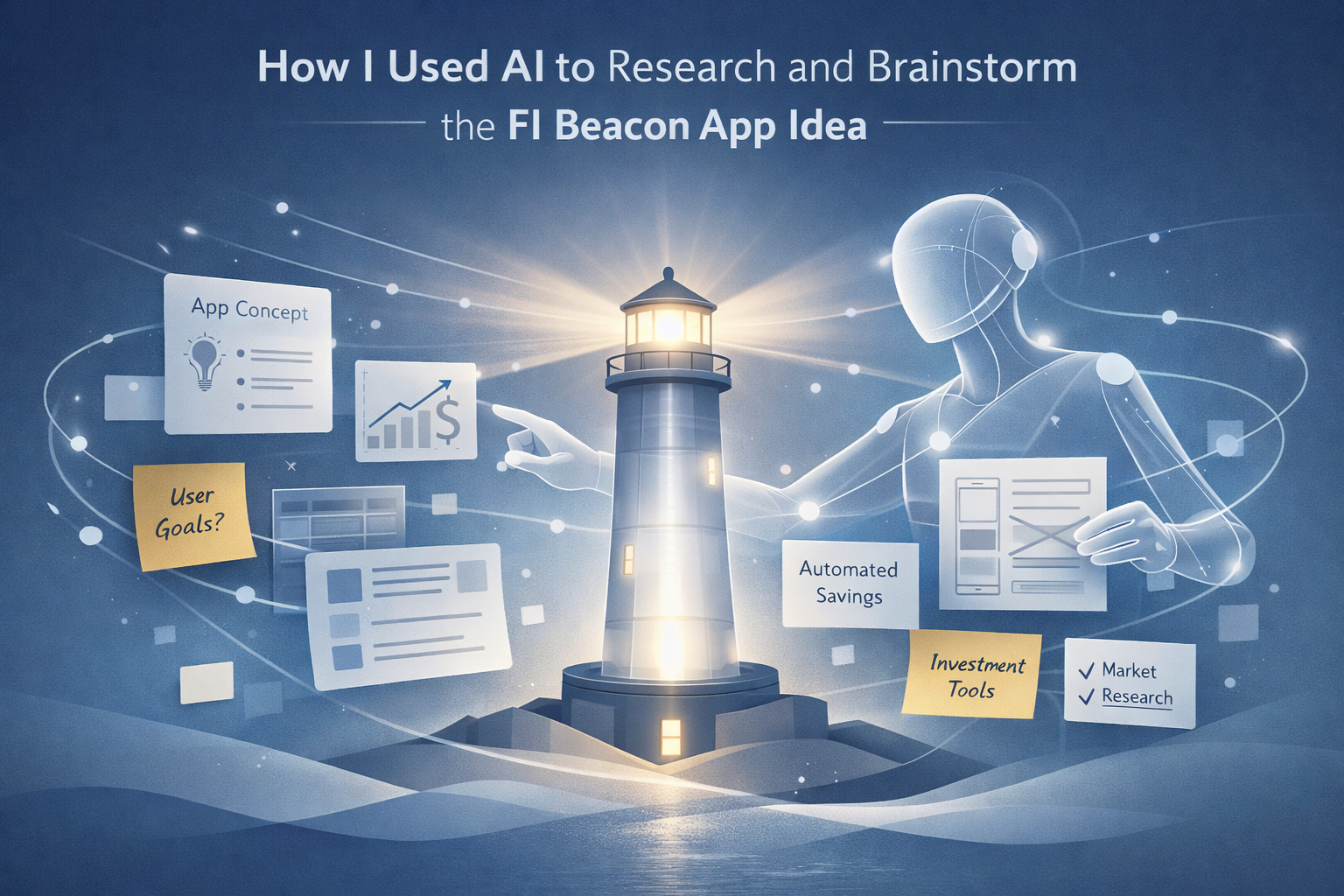
The real problem was not coding
A lot of people think the hardest part of building an app is the code. Sometimes it is. But very often, the hardest part is figuring out what is worth building in the first place. You can spend weeks or months building a polished product that nobody wants. Nice UI, clean architecture, zero users. A classic developer love story.
So before jumping into implementation, I started where I should have started all along: with research and brainstorming. And this is where AI became genuinely useful. Not because it magically gave me a million-dollar app idea. But because it helped me think more clearly.
That is the main point of this post:
AI is useful for structured research and brainstorming, but you still need judgment.
AI can help you generate options, compare directions, challenge assumptions, and organize your thinking. What it should not do is replace your brain completely. You still need taste, common sense, and the courage to say, “Nope, that idea sounds clever but I would never use it.”
My starting point
I knew a few things about my situation:
- I had a server where I could deploy applications
- I wanted to build web apps, ideally mobile-first
- I wanted to use AI as much as possible during development
- I wanted something targeted, useful, and with some market potential
- I did not want to build random features just for the fun of generating code
So I asked ChatGPT for app ideas. Nothing fancy. I basically said: give me ideas for web applications that could have a real audience, could be built in a practical way, and would also help me learn how to work with AI in development. And that was already an important lesson.
Lesson 1: Don’t ask AI for “a startup idea”
That usually gets you a buffet of generic answers.
You know the type:
- task manager for teams
- habit tracker with gamification
- AI note-taking app
- social platform for dog owners who also do yoga
Okay, maybe not that last one. But give it five minutes.
What worked better was giving AI constraints. I was not looking for “the next unicorn.” I was looking for something that matched:
- my interests
- my available time
- my existing infrastructure
- my curiosity
- a real problem people might care about
That makes the brainstorming much more useful.
Instead of asking:
“Give me app ideas.”
Ask something closer to:
“Give me app ideas for a web application that can be built lean, solves a clear problem, has a niche audience, and could be validated before building too much.”
That shift matters a lot.
The moment one idea stood out
Out of the list of ideas, one of them caught my attention: an app related to financial independence. That was the spark that eventually became FI Beacon. This was not random.
It stood out because it checked several boxes at once:
- I am genuinely interested in financial independence
- I understood the problem space enough to care
- I could imagine myself using the product
- It felt useful, not just technically interesting
- It seemed focused enough for an MVP
- It had a clear audience
That last point is important. A lot of ideas sound cool in theory, but if you cannot clearly picture who the product is for, you are already walking into a fog.
With FI Beacon, I could picture the user immediately:
someone interested in financial independence, who wants a simple way to track progress without needing a giant spreadsheet or some overcomplicated finance app that wants access to half their personal life.
That felt promising.
Why AI helped here
This is where AI was actually valuable. Not because it told me “build this exact thing and your future is secured.”
It helped in a more practical way:
- it generated multiple directions quickly
- it let me compare ideas side by side
- it helped me ask follow-up questions
- it helped me move from vague excitement to clearer product thinking
That is the kind of AI usage I trust a lot more. Not “AI, please run my entire life.”
More like:
“Help me think through this idea without me opening 27 tabs and forgetting why I opened the first one.”
From app idea to product thinking
Once I picked the financial independence angle, I continued the discussion with AI and started exploring the shape of the product.
At that point, I had enough context to say:
- I want a web app
- I want it to be responsive and mobile-first
- I want it to feel focused
- I want it to solve a real problem
- I want it to avoid unnecessary complexity
- I want it to be privacy-friendly
One thing I liked quite early was the idea that the app should not require sensitive banking data. That was a strong angle. Instead of saying, “Connect all your accounts, upload your soul, and maybe tell us your blood type,” the product could stay simple and privacy-first. That made the concept much more attractive to me. It also made the product positioning clearer.
FI Beacon would not try to be a giant personal finance empire. It would focus on helping users track their progress toward financial independence in a clean, simple way. That is a much stronger starting point than trying to build “an app that does everything.”
Because apps that do everything usually do one extra thing very well:
confuse people.
Lesson 2: Use AI to narrow down, not just expand
This is one of the biggest mistakes people make. They use AI only to generate more and more options. More ideas. More features. More possibilities. More everything. Very soon, they are drowning in “potential.”
The better use is this:
Use AI to reduce uncertainty.
You want AI to help answer questions like:
- Which idea has the clearest audience?
- Which idea would I personally care enough to finish?
- Which idea can be tested simply?
- Which idea is narrow enough for an MVP?
- Which idea avoids unnecessary complexity?
That is exactly what started happening with FI Beacon. The idea became more focused over time, not bigger. That is a very good sign.
How to find app ideas with AI
Here is the repeatable process I would recommend if you want to use AI to find app ideas.
Step 1: Start with your context
Do not ask AI for ideas in a vacuum.
Give it your real constraints:
- what kind of apps you want to build
- what technologies or platforms you are comfortable with
- how much time you have
- whether you want B2C or B2B
- whether you want a niche product or broader audience
- what topics you already care about
Your goal is not to impress the AI with a dramatic prompt. Your goal is to get ideas that are relevant to your actual situation.
In my case, the useful ingredients were:
- web applications
- mobile-first
- AI-assisted development
- practical market potential
- something I would enjoy working on
That already cuts out a lot of nonsense.
Step 2: Ask for multiple directions
Once you have context, ask AI for several different app directions. Not just one. You want variety at this stage. The goal is not to find the perfect idea immediately. The goal is to create a small pool of candidates worth examining further.
Then look for the idea that creates a reaction in your head like:
“Oh. That one is interesting.”
That matters more than people admit. If an idea feels dead to you on day one, it probably will not get more exciting when you are fixing edge cases three weeks later.
Step 3: Filter by interest and usefulness
This is where your judgment matters.
For each idea, ask:
- Would I actually use this?
- Do I understand the user?
- Can I explain the value simply?
- Does this solve a real problem?
- Can I build a small first version?
- Would I still care about it after the initial excitement wears off?
This is where FI Beacon won for me. It was not just “a possible app.” It was an app idea connected to a topic I genuinely like. That makes a huge difference.
Because when you are building with AI, you can generate code faster than before. But you still cannot outsource motivation.
At least not yet.
Maybe AI agents will eventually send emotional support messages like:
“You’re doing great. This validation bug is not your fault.”
Honestly, I would pay for that.
How to validate an idea before building too much
This part matters just as much as brainstorming. You do not want AI to push you into building the wrong thing faster. That is not progress. That is just more efficient regret.
A good early validation process can be surprisingly simple.
1. Check whether the problem is clear
Can you describe the problem in one or two sentences?
For FI Beacon, the problem was something like this:
People interested in financial independence need a simple way to track progress, goals, and direction without relying on complicated spreadsheets or overly intrusive finance apps.
That is already concrete enough to work with.
2. Check whether the audience is identifiable
Can you describe who the product is for?
If the answer is “everyone,” that usually means “no one.”
In this case, the audience was much clearer:
people who care about financial independence and want a simpler, more privacy-friendly way to track progress.
3. Check whether the first version is small enough
This is a big one.
AI is dangerous here, because it is very good at helping you imagine a huge product. You ask for a simple app, and five minutes later you are discussing multi-tenant architecture, AI copilots, 17 integrations, and three pricing tiers.
Suddenly your MVP has the scope of a nervous breakdown.
A good idea for an MVP should have a very small first useful version.
FI Beacon could start small:
- monthly financial snapshots
- FI target
- simple dashboard
- progress tracking
- goals
That is much healthier than trying to build the ultimate financial platform on day one.
4. Check whether the idea has positioning
Why this product and not something else?
This does not need to be fancy. It just needs to be clear.
A privacy-first financial independence tracker is already more interesting than “another finance app.”
Clarity wins.
How AI helps you think more clearly
This is the part I appreciate the most now. AI is not only useful for code generation. It can act like a thinking partner when you are still shaping the product.
A few things it does really well:
It helps structure messy thoughts
You may already have good instincts, but your thoughts are scattered.
AI can help turn that into something clearer:
- problem
- audience
- value proposition
- feature priorities
- risks
- open questions
That alone is extremely useful.
It helps expose weak ideas
Sometimes an idea feels exciting until you try to explain it properly. Then it starts wobbling.
AI is good at helping you pressure-test things.
You can ask:
- what is weak about this idea?
- what assumptions am I making?
- what is the smallest version of this?
- why might people not pay for it?
- what existing behavior am I trying to replace?
That is where the value is.
Not blind agreement. Friction.
It helps you avoid building random features
This is one of the biggest traps in side projects. You get excited, you start building, and then every new feature sounds reasonable. A bit later, your app has fifteen sections and the original purpose is hiding in a corner.
AI can help you organize priorities and keep asking:
- what is core?
- what is optional?
- what is premature?
- what belongs in MVP?
- what should wait?
That makes it much easier to avoid building a product-shaped pile of unrelated enthusiasm.
What AI did not do
It did not magically validate the app for me. It did not guarantee demand. It did not replace my own interest, taste, or judgment. It did not know, by itself, whether FI Beacon was the right idea for me.
That part still came from me.
This is important because there is a lot of hype around AI, especially around AI agents in software development. Sometimes the story sounds like this:
- Tell AI to build a startup
- Go to sleep
- Wake up rich
That has not been my experience.
My experience has been much more grounded, and honestly more useful:
- AI helped me research faster
- AI helped me brainstorm better
- AI helped me organize product thinking
- AI helped me move from vague idea to clearer direction
That is already a big deal. You do not need magic for AI to be valuable. You just need leverage.
How to avoid building the wrong thing
If I had to boil this post down into one practical takeaway, it would be this:
Do not use AI only to accelerate building.
Use it to slow down and think before building.
That sounds backwards, but it is one of the smartest ways to use it.
Before you start generating code, use AI to answer:
- What problem am I solving?
- Who is this for?
- Why would they care?
- What is the smallest useful version?
- What should I deliberately leave out?
- Why am I excited about this idea?
Those questions can save you a lot of time.
Because the worst-case scenario is not failing after trying something small. The worst-case scenario is spending a long time building something polished that never had a clear reason to exist.
AI can help reduce that risk, but only if you use it for thinking, not just output.
The origin of FI Beacon
So that is how FI Beacon started. Not with a business plan. Not with a perfect product spec. Not with a magical moment of startup genius.
It started with curiosity, some healthy skepticism about AI, a desire to build something real, and a structured brainstorming process that led me toward an idea I actually cared about.
That mattered.
Because once the idea connected with my own interests, it became much easier to keep exploring it, shaping it, and eventually building it.
FI Beacon felt like a good fit not because AI declared it a winner, but because AI helped me uncover an idea that made sense for me.
That is a much better role for AI.
Less fortune teller.
More thinking partner.
A process you can copy
If you want a simple version of the process I used, here it is:
- Start with your real constraints and interests
- Ask AI for several app directions, not one
- Look for ideas that are both useful and personally interesting
- Use AI to pressure-test the best options
- Identify the clearest audience and problem
- Cut the scope down to a small first version
- Keep your judgment switched on the entire time
That is the repeatable part.
You do not need to wait for the perfect idea. You need a good enough idea, a clear enough problem, and a process that helps you avoid wasting months building the wrong thing.
Final thoughts
If you are skeptical about AI in software development, I get it.
I was too.
In some ways, I still am. I do not think AI should be trusted blindly, and I definitely do not think every AI-generated suggestion deserves a standing ovation.
But I have become a lot more positive about one thing:
AI is incredibly useful when you use it to bring structure to messy thinking.
That is exactly what it did for me here. It helped me move from “I want to build something” to “this is the product I want to explore.”
And that is how FI Beacon began.
Not as a pile of generated code.
But as a better question, followed by better thinking.
And yes, it is slightly funny that the guy who was skeptical about AI ended up building apps with it with very little hand-written code.
Life comes at you fast.
Especially when AI is autocomplete on steroids.
If you are thinking about building your own app with AI, start with the idea first, not the code.
The code can come later.
The judgment cannot.

No comments yet.