What Do You Do While AI Writes the Code?
I have been using AI to code more and more, and one small thing keeps bothering me.
Not the quality of the code. Not even the prompting part.
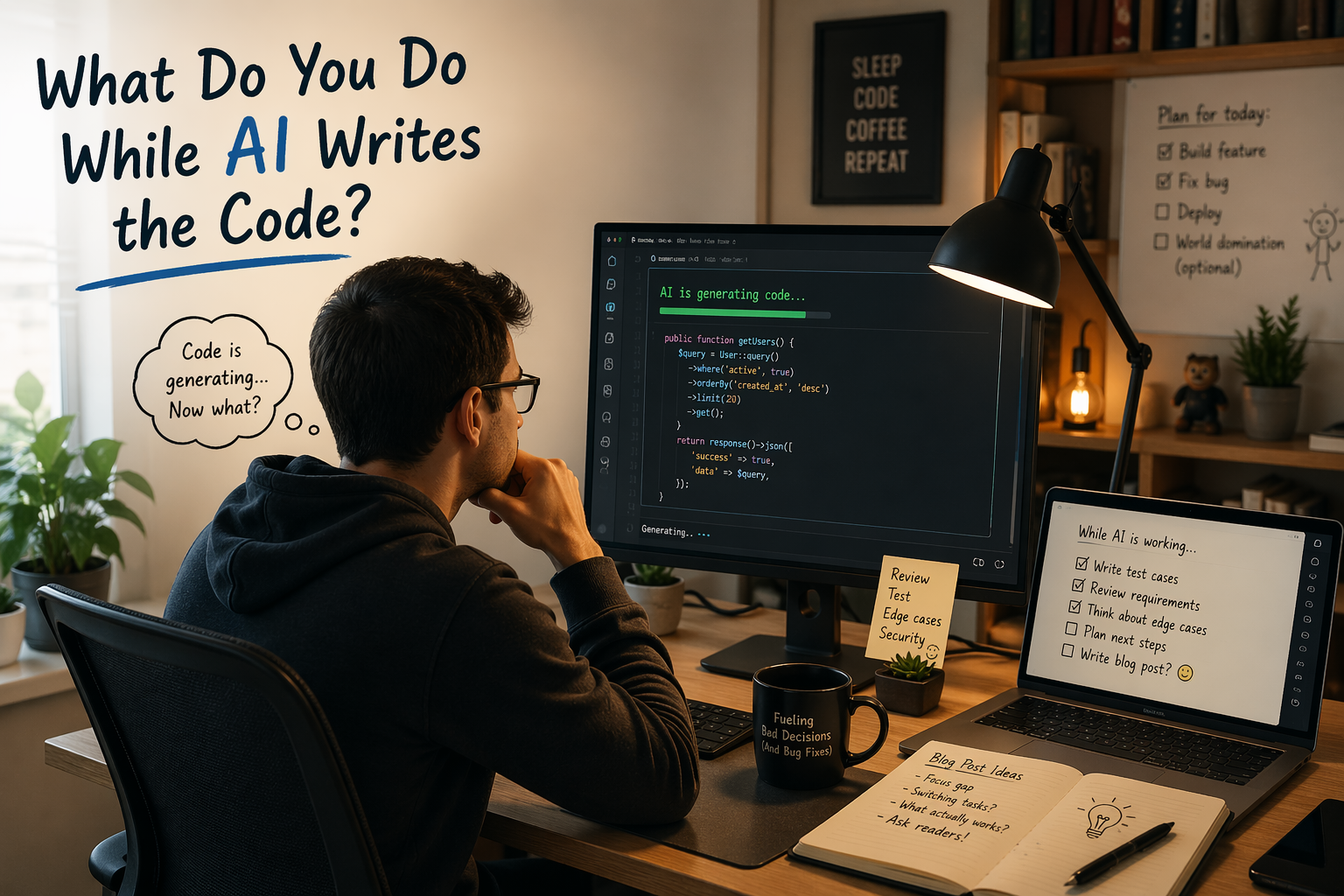
The weird part is what happens while the code is being generated.
That in-between time feels stranger than I expected. I am still in the task, but I am not actively typing. I am waiting, but not really resting. I could switch to something else, but my brain does not always come along nicely for the ride.
And that has turned out to be its own little productivity puzzle.
The funny part is that even while writing this, AI is generating code for me somewhere else. So apparently my current solution is to write a blog post about the problem while the problem is actively happening. Which is either very efficient or a beautiful example that I still do not fully know what I am doing.
Probably both.
A quick note before we continue: this post was created with the help of AI.
I use AI as a thinking partner to help me structure messy thoughts, explore ideas faster, improve flow, and sometimes save me from staring at a blank page like it personally offended me.That said, the opinions, experiences, and final judgment are still mine. AI helps me write clearer and faster, but it does not get to sneak in and become the author of my personality.
So yes, AI helped shape this post — but the relaxed coder behind it is still very much human.
The strange new gap in coding
Before AI tools became part of the workflow, coding time was more straightforward. You were either writing code, debugging code, reading docs, testing something, or pretending to fix a bug while actually wondering why you chose software development as a personality trait.
Now there is this new state.
You ask AI to generate something, and for a moment the machine is busy, but you are also still mentally attached to the task. That sounds like free time. In practice, it often does not feel like free time at all.
It feels like suspended attention.
You are not done with the feature. You are not properly available for another deep task. And if you try to move too far away mentally, part of you stays behind like a browser tab that keeps playing audio somewhere and refuses to tell you which one it is.
That is the part I did not really expect.
What I thought I would do
At first, I assumed the answer was simple.
While AI writes the code, I will just work on something else.
Very reasonable. Very mature. Very productive-sounding.
The problem is that switching sounds easier than it feels.
In theory, I can use that time to answer a message, plan another feature, write documentation, think about a blog post, review something in the app, or organize a task list. There is always something else to do. I do not exactly suffer from a lack of unfinished work. Quite the opposite, really. My backlog has a healthy level of confidence for something that mostly consists of future me’s problems.
But when I try to jump into a second task, my focus is split. I am not fully with the new thing, because part of me is still waiting for the AI result. I am also not fully with the original task, because I already stepped away from it.
So instead of doing one thing well, I sometimes end up doing two things half-well.
That was annoying to notice.
Why switching is harder than it sounds
I think part of the issue is that AI coding changes the shape of work, but not the need for judgment.
The typing can be delegated.
The thinking cannot.
Even when AI is generating code, I still know I will need to review it, check whether it stayed in scope, verify that it did not creatively interpret a requirement into a whole new product, and make sure it did not miss something important while sounding extremely pleased with itself.
So my brain stays on standby.
It is a bit like waiting for someone to bring you a draft of something you still have to approve. You are not doing the drafting yourself, but you are still responsible for what comes next. That responsibility keeps a thread of your attention connected.
And that thread is enough to make task switching awkward.
Not impossible.
Just awkward in a very modern way.
What I have tried so far
I do not have a perfect answer here, which is exactly why I wanted to write this post in the first place. But I have noticed a few patterns.
Switching to a completely different task
This works the worst for me.
If I jump into something unrelated, especially something that needs real concentration, I often end up getting pulled back too quickly. Either the code finishes sooner than expected, or I check on it too often, or I never really settle into the second task at all.
That kind of switch looks productive from the outside, but for me it often feels messy.
Staying glued to the generation
This is also not great.
There is a special kind of fake productivity in staring at code being generated as if my presence adds moral support. It does not. I am basically supervising autocomplete and pretending that counts as active work.
Sometimes it makes sense to stay close if I know the result will need immediate follow-up. But a lot of the time, just hovering there is not useful. It mostly creates the illusion of control, which developers are very good at enjoying.
Doing something adjacent to the task
This feels more promising.
What seems to work better is staying near the same problem without trying to fully switch contexts. That could mean reviewing requirements, writing down what I want to check in the generated code, thinking through edge cases, making a small test checklist, or capturing a note about the feature while it is still fresh in my head.
That kind of work fits the same mental neighborhood.
I am not asking my brain to move house. Just to go into the next room.
That part matters.
Maybe the real job changes
The more I use AI for coding, the more I feel that my role shifts upward a bit. Less raw typing. More steering, reviewing, deciding, and catching nonsense before it gets promoted into a feature.
That does not mean the work becomes effortless. It just becomes different.
And I think that “different” part is still being figured out by a lot of us in real time.
We are learning new tools, but we are also learning new rhythms. When do you stay with the task? When do you branch off? When do you write the next prompt? When do you check the output? When do you stop pretending you are multitasking and admit you are just context-switching with extra steps?
That is the part I find interesting.
Because this is not only a tooling question. It is also an attention question.
What I am experimenting with now
At the moment, I am trying a simpler rule: when AI is generating code, do something that supports the same task instead of escaping into a different one.
So not “what else can I do right now?”
More like “what else around this task would still be useful right now?”
That might be:
- writing a quick review checklist
- noting expected behavior
- listing edge cases
- preparing what I want to test
- spotting places where the AI might overbuild
- writing down the next question before I forget it
This feels a bit more realistic for how my attention actually behaves.
It is not glamorous.
But it is honest.
And honest workflows tend to survive longer than imaginary perfect ones.
I am curious what you do
This is the part where I genuinely want to hear from other people using AI for coding, because I do not think I have fully solved this yet.
When AI is writing code for you, what do you actually do?
Do you stay with the task and review things nearby? Do you switch to something else completely? Do you write tests, plan the next step, check email, stare at the screen with quiet suspicion, or wander into a second task and then realize five minutes later that your brain never really moved?
I suspect a lot of us are dealing with the same strange gap, just in slightly different ways.
So I would love to hear your version of it in the comments:
- Do you switch tasks while AI is generating code?
- Do you stay focused on the same feature in a lighter way?
- Have you found a rhythm that actually works?
- Or are you also still experimenting?
I am genuinely curious, because right now I do not think the answer is “just multitask better.”
That sounds nice.
It also sounds like something said by a productivity guru who has never been ambushed by three browser tabs, one half-finished prompt, and an AI agent enthusiastically rewriting the wrong file.
Final thoughts
AI has made coding faster in one sense, but it has also created a new kind of in-between time that feels surprisingly hard to use well.
That is what I keep noticing.
The machine is busy. The feature is not finished. My attention is somewhere in the middle.
I am still figuring out what to do with that space.
If you are using AI for coding too, I would really like to know how you handle it.

No comments yet.